Your sketch of a sword, lantern or lunchbox looks fine but feels empty. Good prop design fixes that by giving every object an owner, a history and a job in the story.
This guide sits within our wider concept art coverage.
| Item | Key fact |
|---|---|
| What prop design is | Design of props for theatre, film, television and similar media |
| Who directs the work | Prop designers work under the art director or a similar lead |
| Where it sits in production | Concept art is typically one of the earliest production phases |
| Typical prop subjects | Vehicles, weapons and similar objects |
| Link to the real world | Prop concept artists sometimes work with a practical effects team |
These points come from Wikipedia’s prop design entry and KitBash3D’s concept art overview. Job titles and workflows change between studios, so check the sources before you rely on them.
What a prop actually does in a story
Props are objects used in a production; distinctions between props, costumes and scenery depend on the production. Wikipedia defines property design as the design of props for use in theatre, film, television and similar media.
That definition is practical, but the creative job is bigger. A prop can reveal who owns it, where they have been and what they are afraid of, without a line of dialogue.
Think of a battered thermos with a child’s sticker on it. You instantly know there is a family somewhere, and that someone has been travelling a long time.
Props do four main jobs:
- Characterise: they show taste, wealth, habits and flaws.
- Place: they anchor a setting in a time, culture or technology level.
- Drive action: a key, a weapon or a map moves the plot.
- Guide the eye: a clear, readable object tells the viewer where to look.
Where props fit in the production pipeline
Prop designers do not work alone. Wikipedia notes that designers of props work in liaison with costume, set and sound designers, under the direction of the art director or a similar lead.
KitBash3D’s overview says concept art is typically one of the earliest production phases. Your prop sketches can become references for teams that build or depict those objects.
The same overview lists prop designers as concept artists who interpret vehicles, weapons and everything in between. It adds that a prop concept artist will sometimes work closely with a practical effects team to produce real objects for actors to touch.
That matters for how you draw. If an actor must hold it, consider its weight, grip points and any moving parts.
Start with the owner, not the object
Before you draw, write a few lines about the person who uses the item. A prop with no owner tends to look like a catalogue entry.
Answer these questions in a notes file first:
- Who made it, and with what skills and materials?
- Who owns it now, and how did they get it?
- How is it used every day, and how is it misused?
- What has damaged it, repaired it or changed it?
- What does the owner want to hide or show about it?
The answers become visible design decisions. A repaired handle suggests sentimental value; a polished blade next to a ragged sheath suggests a recent upgrade or a theft.
Shape, silhouette and readability
A prop must read at thumbnail size. Fill a page with small, solid black shapes first and pick the ones that you could identify without detail.
The same discipline applies to characters, and our guide to silhouette design covers it in depth. For props, ask whether a stranger could name the object from its outline alone.
Then add a single distinctive feature. One asymmetrical vent, one oversized dial or one broken chain link gives the object an identity that people remember.
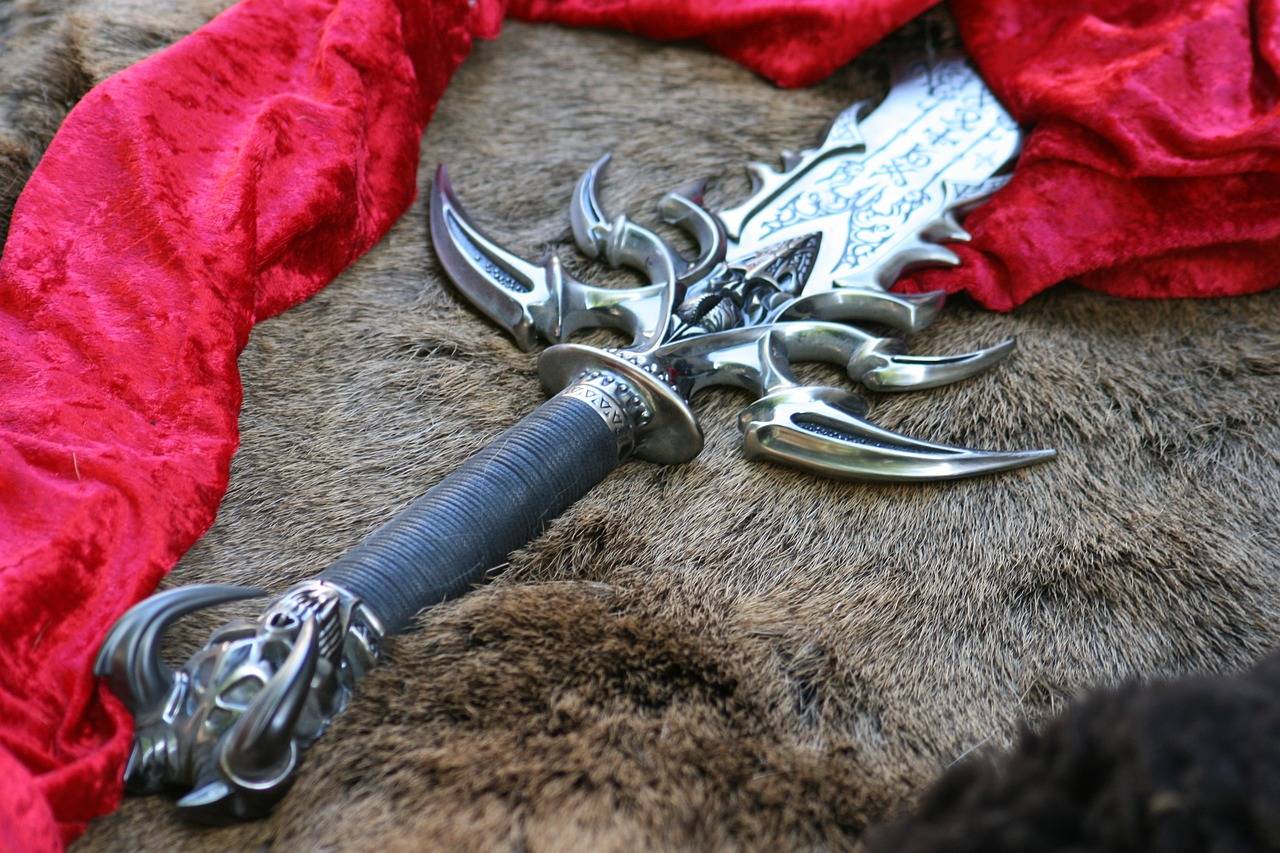
Keep a few shape families consistent across a set of props from the same culture. Rounded and riveted gear suggests one maker; angular and welded gear suggests another.
Materials, wear and the evidence of use
Surface storytelling is where props come alive. Wear should follow use, not decoration.
- Contact points: paint rubs off where hands grip and where the item rests.
- Edges and corners: chips and scratches collect where objects get knocked.
- Stains and residue: oil, soot, salt and dust show the environment it lives in.
- Repairs: mismatched screws, tape or patches show budget, urgency and skill.
Avoid sprinkling scratches evenly across the whole object. Even grime looks like a texture overlay, while clustered wear looks like a life.
Props can also borrow from creature work. Bone, shell, hide and sinew make strong materials for a culture that hunts, and our notes on creature design show how anatomy can inspire an object’s form.
Presenting a prop for production
Production teams need more than one pretty view. A clear prop sheet usually includes the following:
- A hero view, ideally at a slight angle with clean lighting.
- Orthographic views, such as front, side and top, so others can build it.
- A scale reference, such as a hand holding it or a figure beside it.
- Callouts for materials, moving parts and details that need close-ups.
- A small in-context sketch that shows how it is carried or used.
A history is not always visible, so add short notes. One sentence such as “inherited, re-handled twice” helps the next artist carry your intent forward.
Theatre shows how old this craft is. Wikipedia notes that in Shakespeare’s plays, Hamlet used a skull as a prop, a reminder that one well-chosen object can carry a whole scene.
Common mistakes and how to fix them
Most weak props fail for the same few reasons. Spotting them early may reduce later rework.
- Too much detail: every surface has greebles, so nothing stands out. Leave calm areas so the eye can rest on the key feature.
- No function: the object looks cool but nobody could use it. Mime holding it and check that a hand fits.
- Generic styling: it could belong to any film or game. Tie its shapes and materials to the world’s culture and technology.
- Flat storytelling: the history is only in your notes. Move at least one story beat onto the object itself, such as a repair or a personal mark.
- Ignoring scale: nobody can tell how large it is. Add a hand, a figure or a familiar object beside it.
A useful test is to hide the object’s name and show it to a friend. Ask them three things: what it is, who might own it and whether it has been used a lot. If they answer well, the design is doing its job.
Practise by choosing an ordinary object, such as a key, and designing it for three different owners. A smuggler, a monarch and a child will each need a different key, and the contrast trains you to let story drive form.
Frequently asked questions
What is the difference between a prop and a set piece?
Show answer
A prop is usually something characters handle or carry, while set pieces are larger parts of the environment. The line blurs for items like vehicles, so check how your project’s art department defines them.
Do I need three-dimensional software to design props?
Show answer
Not always. Many prop concepts begin as sketches or paintings, though some studios expect rough digital blockouts. Learning basic form and perspective helps in either case.
How much backstory should a prop have?
Show answer
Enough to answer who made it, who owns it and how it was damaged. A few lines are usually sufficient, as long as each one shows up in the design.
How do I make a prop look believable?
Show answer
Base the shape on function, place wear where use happens and keep the materials consistent. If the prop will be built for an actor, think about weight and grip.